
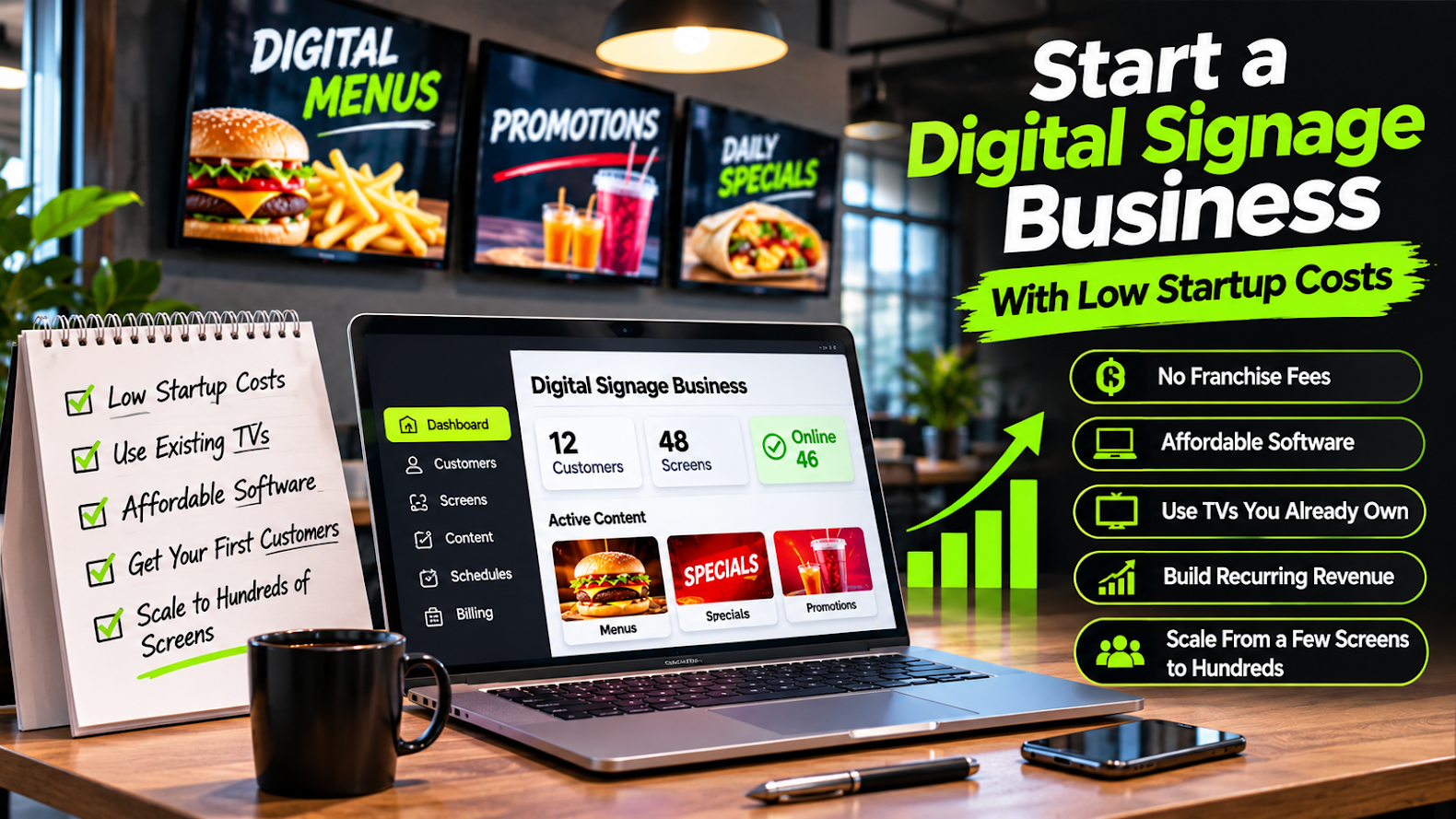
Starting a business often comes with significant financial commitments. Traditional franchises may require substantial upfront investments, equipment purchases, licensing fees, and ongoing operating expenses. For entrepreneurs interested in technology and business services, digital signage offers an alternative worth considering.
Restaurants, convenience stores, retail shops, gyms, and other businesses use digital screens to display menus, advertisements, promotions, and announcements. While demand for these services creates opportunities, many business owners still need assistance setting up and managing their displays.
Instead of developing proprietary software or investing in expensive hardware inventory, entrepreneurs can join a digital signage reseller program and build a service business around existing technology.
With affordable software, compatible streaming devices, and a practical customer acquisition strategy, it’s possible to begin with a few screens and gradually expand into a larger digital signage operation.
Digital Signage Franchise vs. Reseller: What’s the Difference?
Entrepreneurs researching the digital signage industry may encounter several business models, including franchises, independent installation companies, software resellers, and managed service providers.
A traditional franchise generally involves operating under an established company’s brand and business system. Depending on the franchise, this may include initial fees, royalties, operating requirements, and contractual obligations.
A digital signage reseller typically operates more independently.
Rather than purchasing a traditional franchise, a reseller uses an established software platform to provide digital signage services to customers.
The reseller may handle sales, installations, content management, customer support, and monthly billing.
This model can offer greater flexibility in how services are packaged and priced, although the exact level of independence depends on the software provider’s agreement.
Importantly, a reseller arrangement is not automatically a franchise, and entrepreneurs should review the applicable contract before making a commitment.
1. Avoid the Cost of Developing Software
One of the largest potential expenses in starting a digital signage technology company is software development.
Building a custom platform can involve hiring developers, creating device applications, establishing cloud infrastructure, developing content scheduling tools, and maintaining security.
Even after launch, software requires ongoing maintenance, bug fixes, updates, and customer support.
For entrepreneurs whose primary goal is to sell digital signage services, developing an application may not be necessary.
Platforms such as Billiie offer existing digital signage technology that resellers can use to manage customer screens.
Billiie’s commercial reseller offering includes centralized customer management, remote content updates, scheduling capabilities, and customer billing integration.
This allows entrepreneurs to focus their resources on customer acquisition and service delivery instead of software development.
2. Use Existing Televisions to Reduce Hardware Expenses
Another advantage of modern digital signage is the ability to use televisions that businesses already own.
Many restaurants, convenience stores, and retail shops have TVs installed but rely on USB drives or manually connected devices to display content.
With compatible hardware and software, these televisions can often become remotely managed digital signage displays.
For example, a restaurant with four existing televisions may only need compatible streaming devices, software setup, and digital menu designs.
This reduces the customer’s initial investment and can make the reseller’s service easier to sell.
Billiie supports compatible devices such as Amazon Fire TV and Android TV, allowing resellers to offer solutions without requiring every customer to purchase specialized commercial displays.
However, device compatibility, operating hours, screen placement, and long-term reliability should be evaluated before installation.
3. Understand the Basic Startup Expenses
A digital signage reseller business can be started with relatively modest expenses compared with developing proprietary technology or opening a traditional retail location.
Actual startup costs depend on the services offered, the equipment purchased, and the number of customers acquired.
Here is an illustrative budget for a small home-based digital signage service.
Startup expenseEstimated costWebsite and domain$50–$200Demo TV or existing television$0–$250Compatible streaming device$30–$60Initial marketing materials$50–$150Software and demo subscriptionsVaries by planBusiness registration and insuranceVaries by locationIllustrative subtotal, excluding variable expenses$130–$660
These estimates are planning examples rather than supplier quotes. They exclude potentially significant expenses such as licensing, insurance, travel, labor, and customer installations.
Entrepreneurs who already own a laptop and television may be able to reduce initial equipment costs further.
The important principle is to avoid purchasing large quantities of hardware before securing customers.
4. Choose Software With Predictable Monthly Pricing
Software expenses are an important consideration because they affect the reseller’s profit margin.
Some digital signage platforms charge higher monthly fees per screen, while others offer reseller packages or volume-based pricing.
Billiie offers standard digital signage pricing starting at $1 per screen per month, along with separate commercial reseller packages.
For example, a reseller managing 100 screens needs to understand the total software subscription expense before deciding how much to charge customers.
If the reseller charges $8 per screen monthly, 100 screens would generate $800 in monthly gross revenue.
The reseller would then deduct software subscriptions, labor, payment processing, and other operating expenses to determine profitability.
Choosing affordable software can provide greater flexibility when creating service packages for small businesses.
Before subscribing, review the provider’s current reseller plans, screen limits, additional screen pricing, and billing terms.
5. Find Your First Customers Without a Large Advertising Budget
Customer acquisition is one of the most important parts of building a digital signage company.
Fortunately, entrepreneurs don’t necessarily need expensive advertising campaigns to begin.
A practical approach is to start with businesses in the local community.
Restaurants, delis, pizzerias, cafés, convenience stores, and gas stations can be good prospects because their menus and promotions change frequently.
Rather than immediately trying to sell software, ask business owners how they currently update their television content.
A restaurant using USB drives may be interested in managing menus remotely.
A convenience store displaying static advertisements may benefit from scheduled promotions.
A business with several televisions may want someone to handle content changes on its behalf.
A short demonstration can help potential customers understand the service.
Entrepreneurs can also build referral relationships with graphic designers, marketing agencies, IT providers, and television installation companies.
These businesses may already work with customers who need digital signage.
6. Create Service Packages That Generate Recurring Revenue
Digital signage entrepreneurs can earn money through several services, but recurring subscriptions are particularly attractive.
Instead of relying exclusively on installation projects, resellers can charge monthly fees for software access and ongoing screen management.
Consider three example service packages.
Starter — $5 per Screen Monthly
Includes basic screen management and initial setup assistance.
Managed — $10 per Screen Monthly
Includes remote management, scheduled promotions, and a defined number of content updates.
Premium — $15 per Screen Monthly
Includes more frequent updates, additional design services, and priority support.
These are illustrative reseller retail prices, not official Billiie packages.
Installation services, custom menu designs, and new equipment can be charged separately.
By combining one-time project fees with recurring monthly services, entrepreneurs can develop multiple revenue streams.
7. Scale From Five Screens to 500
One of the advantages of digital signage is that entrepreneurs can expand their customer base gradually.
A reseller might begin by managing five screens for a single restaurant.
After establishing a reliable process, they could add more businesses in the same neighborhood.
As the customer base grows, the reseller can target larger businesses with multiple locations.
Consider the following hypothetical revenue scenarios at $8 per screen monthly.
Managed screensMonthly gross revenueAnnual gross revenue5$40$48025$200$2,40050$400$4,800100$800$9,600250$2,000$24,000500$4,000$48,000
These figures assume all screens remain subscribed and paying throughout the year. They do not represent profit or guaranteed earnings.
Growing from five screens to 500 also introduces new operational responsibilities.
Larger resellers may need additional design resources, customer support processes, installation partners, and standardized service agreements.
Centralized management software becomes increasingly valuable as the number of customers and screens increases.
8. Target Multi-Location Businesses for Faster Expansion
Acquiring hundreds of individual small businesses can take considerable time.
Another strategy is to approach companies that operate multiple locations.
Restaurant groups, franchise operators, retail chains, and convenience store businesses may have several screens at each location.
For example, a restaurant group with 20 locations and five screens per location represents 100 screens.
Securing one multi-location customer could therefore produce the same screen count as signing 20 individual businesses with five screens each.
Multi-location customers may also need consistent branding, coordinated promotions, and centralized content scheduling.
These requirements create opportunities for managed digital signage services.
However, larger customers may expect formal service agreements, dependable support, and consistent performance across all locations.
9. Keep Operating Expenses Under Control
Low startup costs don’t automatically guarantee a profitable business.
As the company grows, entrepreneurs should monitor expenses carefully.
Software subscriptions, design time, technical support, customer acquisition, payment processing, and installation labor can all affect profit margins.
For example, charging $5 per screen may be practical for a software-focused service, but it may not cover unlimited design changes or frequent customer requests.
Resellers should define exactly what each monthly package includes.
Charging separately for custom designs, additional revisions, installations, and specialized support can help prevent unexpected labor costs.
It’s also important to track customer retention and the cost of acquiring each new customer.
A sustainable digital signage business depends on providing reliable service while maintaining enough revenue to cover its operating expenses.
10. Build a Business Around Service, Not Just Software
Digital signage software is only one component of the customer experience.
Many businesses want a complete solution that saves them time.
They may need help creating menu designs, scheduling promotions, monitoring screens, or troubleshooting technical issues.
Entrepreneurs who provide these services can differentiate themselves from companies that simply sell software subscriptions.
Billiie’s reseller platform gives service providers tools to organize multiple customers, manage screens remotely, schedule content, and support customer billing through Stripe integration.
The reseller can then focus on building relationships, providing design services, and helping customers maintain professional digital displays.
This combination of technology and ongoing service is what makes the reseller model appealing to entrepreneurs interested in recurring revenue.
Final Thoughts: Start Small, Then Expand
Starting a digital signage company doesn’t necessarily require expensive proprietary equipment, a large office, or a custom-built software platform.
By using compatible existing televisions, affordable software, and a service-focused business model, entrepreneurs can begin with a small number of customers and expand over time.
Compared with some traditional franchise opportunities, an independent digital signage reseller business may offer lower initial expenses and more flexibility in pricing and operations.
However, success still depends on acquiring customers, managing expenses, delivering reliable service, and maintaining long-term relationships.
For entrepreneurs interested in building a technology service business, digital signage offers a practical opportunity to start with a few screens and work toward managing hundreds.